Customer Background and Operational Challenges
A logistics hub in the Philippines recently faced a problem common to many aging industrial facilities in Southeast Asia: limited lifting height due to outdated building structures.
The warehouse operates as a regional cargo distribution hub responsible for receiving, sorting, and dispatching goods. As the business expanded, the weight and volume of handled cargo increased significantly. However, the warehouse was constructed many years ago, and its original design did not anticipate the need for heavy lifting equipment or high pallet stacking.
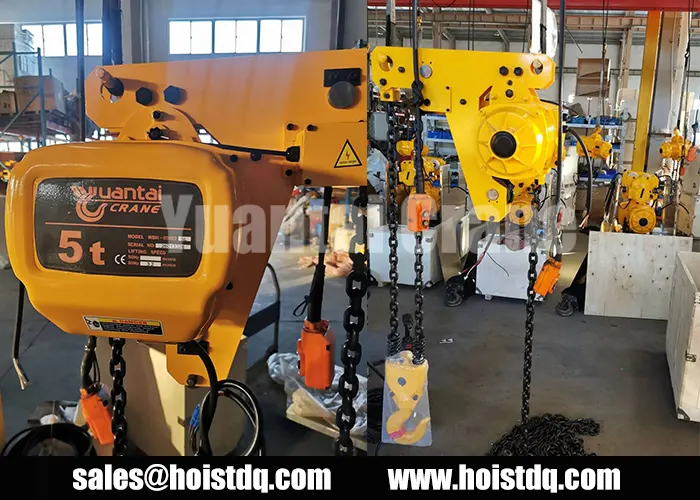
Existing Limitations
Before the upgrade, the facility relied primarily on forklifts and basic lifting tools. This setup became increasingly inefficient and risky when handling cargo approaching 5 tons.
Several key operational problems began to emerge:
Limited headroom under the existing roof beams
Inefficient cargo handling workflow
Increased safety risks when lifting heavy freight
High cost and downtime associated with structural modifications
The warehouse management, therefore, began searching for a lifting solution that could maximize lifting height without changing the building structure.
Site Conditions and Technical Challenges
A technical review of the facility identified several important site parameters.
Site Conditions
- Existing steel I-beams as the potential installation track
- Limited clearance between the beam and the floor
- Cargo types: palletized goods, heavy cartons, cage trolleys, freight containers
- Maximum single load: 5 tons
- Frequent daily loading and unloading cycles
- Indoor warehouse environment with moderate dust and humidity
The hoist lifting equipment needed to provide reliable performance, a compact structure, and sufficient environmental protection.
Engineering Challenges
Several technical constraints had to be addressed:
- Limited installation headroom: Standard electric hoists typically require a larger headroom, which significantly reduces available lifting height.
- Beam compatibility: The trolley system had to match the flange width and beam profile of the existing structure.
- Electrical compatibility: The chain electric hoist had to operate reliably on the local 220V/ 60Hz /60Hz/3-phase power supply.
- Short installation window: The logistics center could not suspend operations for an extended period.
Selecting the Right Hoist for the Job
To determine the optimal hoist equipment, our engineers evaluated several hoist types commonly used in warehouse environments. Here’s a brief overview of why the electric chain hoist, in particular, stood out for this application.
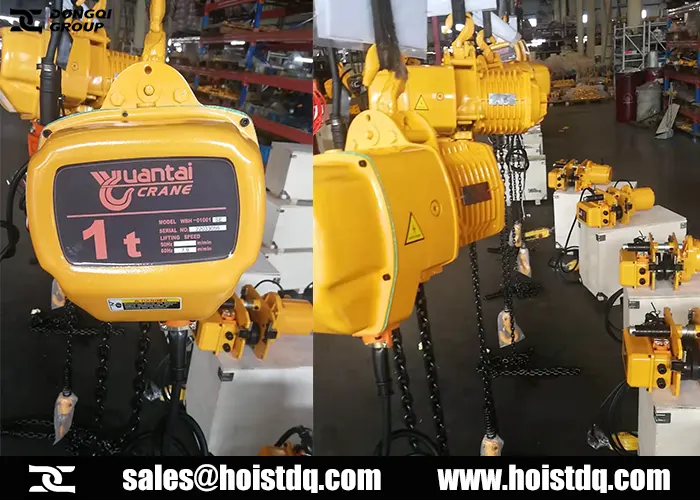
Electric Chain Hoist
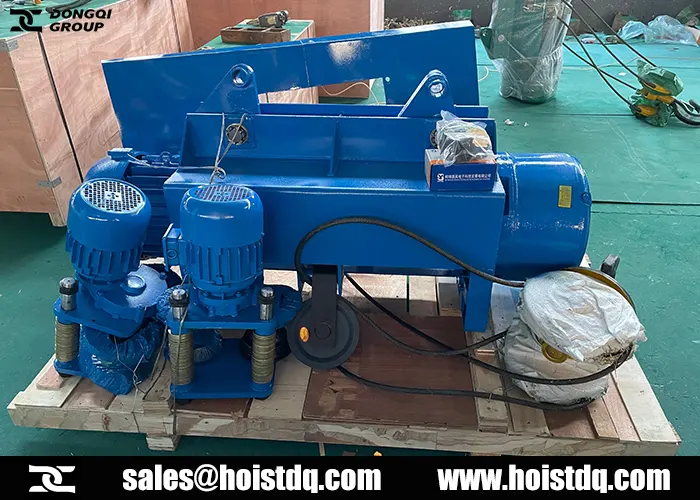
Electric chain hoists are widely used in logistics warehouses due to their compact structure, high reliability, and relatively low maintenance cost. They are particularly suitable for lifting capacities from 0.5 ton to 35 tons, making them ideal for palletized goods and general cargo handling.
Low Headroom Electric Chain Hoist
Low headroom hoists are specially designed for facilities with limited ceiling clearance. By optimizing the chain path and motor arrangement, the vertical distance between the hook and the beam is minimized. This design allows warehouses to maximize lifting height without modifying existing building structures, which was exactly the requirement in this Philippine project.
Electric Wire Rope Hoist
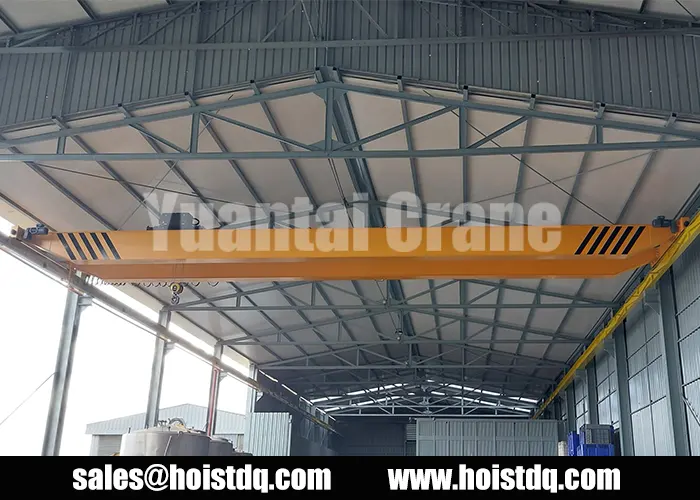
For heavier loads or higher lifting speeds, many large logistics centers use electric wire rope hoists. These are commonly installed on single or double girder overhead cranes and can handle loads from 5 tons up to 80 tons or more. However, wire rope hoists generally require larger installation headroom, making them less suitable for older buildings with limited vertical clearance.
Monorail Hoist & Motorized Trolley Systems
Some warehouses use monorail hoists for linear transport paths. In facilities requiring flexible movement along a beam, electric hoists are often paired with motorized trolleys. For this project, a low headroom hoist combined with a low headroom trolley provided the optimal balance between compact design and operational flexibility.
Solution: 5 Ton Low Headroom Electric Chain Hoist System
To address the customer’s requirements and site constraints, the engineering team proposed a 5 ton low headroom electric chain hoist with a low headroom trolley.
Design Concept
The primary objective was to maximize the available lifting height while keeping the existing warehouse structure unchanged. The low headroom configuration reduces the distance between the hoist body and the hook, allowing it to travel closer to the beam. This compact design enabled the warehouse to achieve the required 6-meter lifting height even with limited beam clearance.
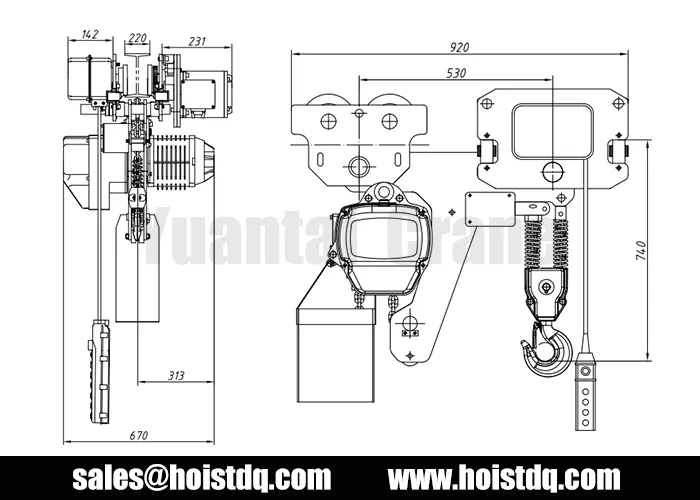
Key Technical Specifications
- Rated Capacity: 5 tons
- Lifting Height: 6 m
- Lifting Speed: 3.2 m/min
- Trolley Speed: 13 m/min
- Power Supply: 220V / 60Hz / 3 Phase
- Protection Class: IP54
Safety Features
The system includes multiple safety mechanisms for reliable operation: overload protection, upper and lower limit switches, electromagnetic motor brake, IP54 electrical control box, and high-strength alloy load chain. These features allow the hoist to operate safely in high-frequency logistics environments.
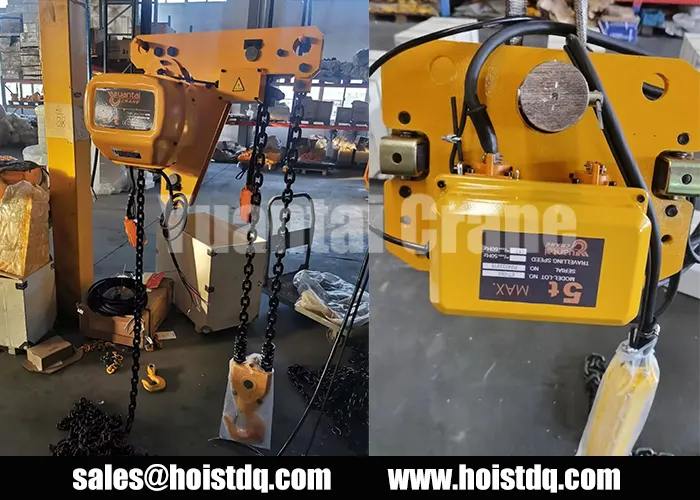
Installation and Implementation Process
Minimizing operational disruption was a key objective of the project.
Pre-Assembly
Before installation, the low headroom hoist and trolley were assembled and tested on the ground, ensuring proper alignment and operation.
On-Site Installation
The installation process involved:
- Lifting the assembled hoist to the existing I-beam
- Mounting the hoist trolley onto the beam flange
- Securing the mechanical components
- Connecting the power supply and control system
- Conducting operational testing and load testing
The installation avoided welding or structural modifications, allowing the warehouse to resume normal operations quickly.
Results: Improved Efficiency and Safety
After the 5 ton electric chain hoist installation, the warehouse experienced noticeable operational improvements.
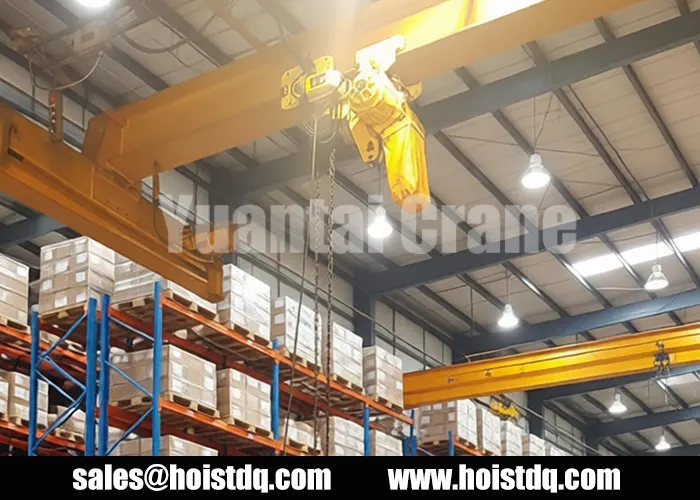
Before the Upgrade:
Limited lifting height
Multiple handling steps required
Heavy reliance on forklifts
Lower operational efficiency
After the Upgrade:
6 meter effective lifting height achieved
Direct lifting of 5 ton pallet loads
Reduced cargo handling steps
Improved workflow efficiency
Increased operational safety
Operational Benefits:
The customer avoided expensive structural modifications while gaining a fully functional lifting solution.
- Reduced infrastructure upgrade cost
- Short installation downtime
- Higher cargo handling efficiency
- Improved workplace safety
The warehouse management summarized the result simply:
“The new low headroom chain hoist allows us to handle heavier and taller cargo without changing the warehouse structure.”
Typical Applications in Logistics and Warehousing
Low headroom hoist systems are widely used where space is limited, but lifting capacity requirements remain high. Typical applications include old warehouse modernization projects, logistics distribution centers, port storage facilities, cold chain warehouses, cargo transfer stations, and industrial storage buildings.
Across Southeast Asia, many warehouses share similar structural constraints, making low headroom electric chain hoists a practical and cost-effective upgrade solution.
Get Your Free Customized Lifting Solution
Is your warehouse also struggling with limited headroom? You don’t need expensive building modifications to significantly improve operational efficiency.
Simply send us your site conditions:
- Clearance under the roof beam
- I-beam dimensions (flange width and height)
- Required lifting capacity and height
- Local power voltage and frequency
Our engineering team will provide a free, no-obligation preliminary equipment selection and headroom calculation, tailored to your specific warehouse layout. We’ll help you find the right lifting solution for your needs.